Ch-2 关系模型
1. 关系结构
1.1 关系定义
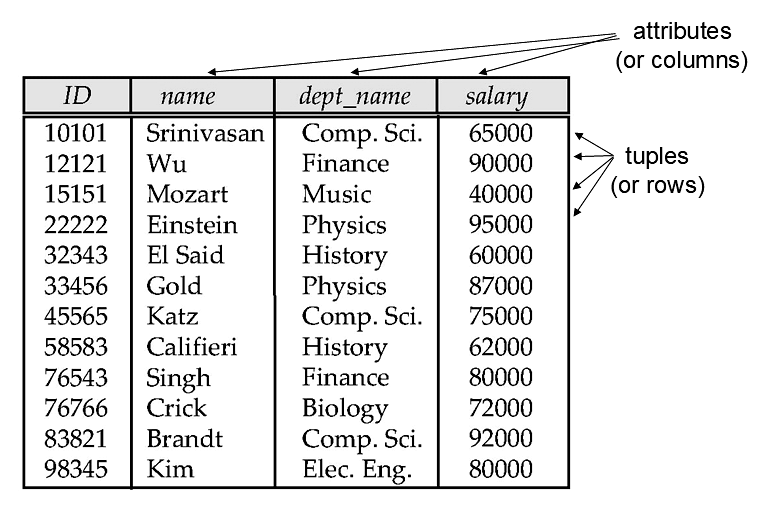
关系模型 (Relational Model) 用关系表示数据。关系在直观上就是一张表,表中的列是属性,表中的行是元组。
形式化地,若 \(D_1,D_2,\cdots,D_n\) 是若干域,则关系 \(r\) 是这些域的笛卡尔积的一个子集:
\[ r\subseteq D_1\times D_2\times\cdots\times D_n \]因此,关系中的每个元素都是一个 \(n\) 元组:
\[ (a_1,a_2,\cdots,a_n),\quad a_i\in D_i \]例如 instructor 可以由 ID、name、dept_name、salary 等属性组成;每一行对应一位教师的记录。
1.2 模式实例
关系模式 (Relation Schema) 描述关系的结构。
若属性为 \(A_1,A_2,\cdots,A_n\),关系模式可写为 \(R=(A_1,A_2,\cdots,A_n)\)。
在具体数据库中,常把关系名和属性列表写在一起,例如:
instructor(ID, name, dept_name, salary)关系实例 (Relation Instance) 是某一时刻关系中实际包含的元组集合。
如果关系实例定义在模式 \(R\) 上,通常记为 \(r(R)\)。
模式相对稳定,实例会随插入、删除和更新变化。类似地,数据库模式 (Database Schema) 是整个数据库的逻辑结构,数据库实例 (Database Instance) 是某一时刻数据库中的实际内容。
1.3 域与空值
域 (Domain) 是某个属性允许出现的值集合。例如 salary 的域可以是合法工资数值集合,dept_name 的域可以是合法院系名称集合。
经典关系模型要求属性值是 原子值 (Atomic Value),也就是不可再分的单个值。这一要求使得关系操作可以把每个属性当作单独的比较和投影单位。
Note
现代数据库中可以使用数组、JSON、嵌套记录等复杂类型,但在关系模型的基本理论中,通常先假定属性值是原子的。
null 是一个特殊值,可出现在任意域中,用于表示未知、不存在或尚未填写。它会让比较、连接和聚集的语义变复杂,因此后续需要三值逻辑来处理。
1.4 无序性质
关系是元组的集合,因此元组顺序没有语义。数据库可以按任意物理顺序存储元组,查询结果如果没有显式 order by,也不应该依赖某种固定顺序。
属性通常也通过名称引用,而不是通过位置引用。实际 SQL 表虽然有列顺序,但查询语义主要依赖属性名。
2. 键与约束
2.1 超键候选键
超键 (Superkey) 是能够唯一标识关系中元组的一组属性。
设 \(K\subseteq R\)。
若任意两个元组在 \(K\) 上取值相同就必然是同一个元组,则 \(K\) 是 \(R\) 的超键:
\[ t_1[K]=t_2[K]\Rightarrow t_1=t_2 \]超键不要求最小。例如在 instructor 中,ID 可以唯一标识教师,那么 {ID, name} 也能唯一标识教师,但它包含了多余属性。
候选键 (Candidate Key) 是最小的超键。最小的意思是不能再删去任何属性,否则就不再能唯一标识元组。
主键 (Primary Key) 是从候选键中选出的一个键,用作关系中元组的主要标识。主键应该稳定、简洁,并且不应为空。
2.2 外键约束
外键 (Foreign Key) 描述两个关系之间的引用关系。
若关系 \(r_1\) 的属性 \(A\) 引用关系 \(r_2\) 的主键 \(B\),则引用值必须能在被引用关系中找到。
更具体地说,\(r_1\) 中每个非空 \(A\) 值都应出现在 \(r_2\) 的 \(B\) 中。
这个约束可以写成:
\[ \forall t_1\in r_1,\ \exists t_2\in r_2,\ t_1[A]=t_2[B] \]其中 \(r_1\) 称为 引用关系 (Referencing Relation)。
其中 \(r_2\) 称为 被引用关系 (Referenced Relation)。
参照完整性 (Referential Integrity) 要求引用不能指向不存在的元组。例如 teaches.ID 引用 instructor.ID 时,任意授课记录中的教师编号都必须能在教师关系中找到。
2.3 模式图
模式图把关系、主键、外键和参照完整性画在一起,便于理解整个数据库的结构。大学数据库中,student、instructor、course、section、takes、teaches 等关系通过主键和外键连接起来。
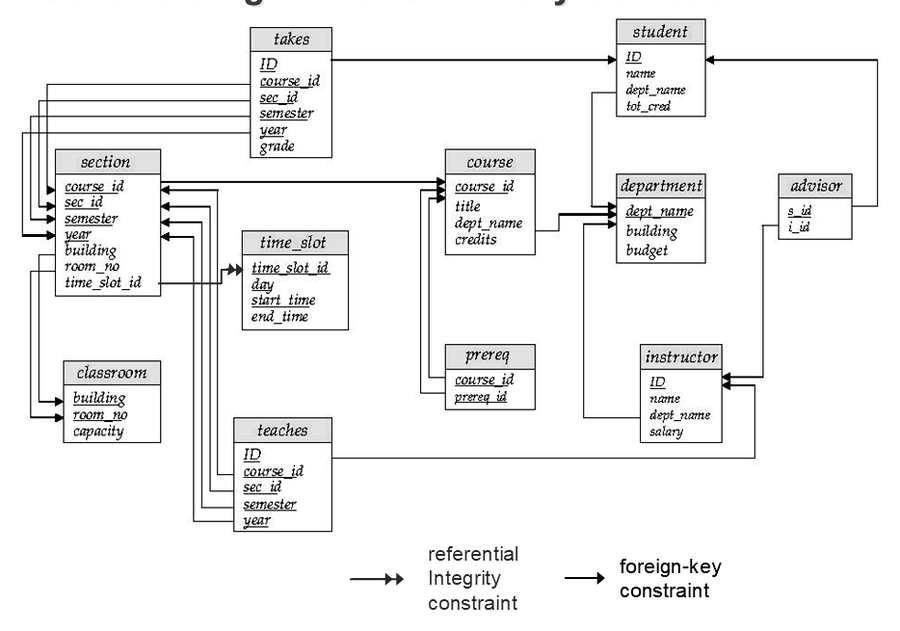
图中下划线属性表示主键。箭头从引用关系指向被引用关系,表示外键和参照完整性约束。
3. 基本代数
3.1 查询语言
关系查询语言可以分为 过程式 (Procedural) 和 非过程式 (Non-Procedural)。关系代数属于过程式语言,因为它不仅说明要什么结果,也说明通过哪些操作一步步得到结果。
三类经典纯查询语言是:
| 语言 | 特点 |
|---|---|
| 关系代数 | 用操作组合表达查询过程 |
| 元组关系演算 | 用元组变量和谓词描述结果 |
| 域关系演算 | 用属性域变量和谓词描述结果 |
这三类语言在表达能力上等价。它们不是图灵完备语言,而是专门用于表达关系查询。
3.2 六个基本操作
关系代数 (Relational Algebra) 的操作以关系为输入,并产生新的关系作为输出。六个基本操作如下:
| 操作 | 记号 | 含义 |
|---|---|---|
| 选择 | \(\sigma\) | 保留满足谓词的行 |
| 投影 | \(\Pi\) | 保留指定属性并去重 |
| 并 | \(\cup\) | 合并两个兼容关系 |
| 差 | \(-\) | 保留只在左侧出现的元组 |
| 笛卡尔积 | \(\times\) | 两个关系的元组两两拼接 |
| 重命名 | \(\rho\) | 给关系或属性改名 |
选择操作保留满足谓词 \(P\) 的元组:
\[ \sigma_P(r)=\{t\mid t\in r\land P(t)\} \]投影操作保留指定属性。由于关系是集合,投影后产生的重复元组会被去除:
\[ \Pi_{A_1,A_2,\cdots,A_k}(r) \]并、差要求两个输入关系 兼容 (Compatible):属性个数相同,并且对应属性的域兼容。
笛卡尔积把两个关系中的元组两两拼接,若 \(r\) 和 \(s\) 的属性名冲突,需要先重命名:
\[ r\times s=\{tq\mid t\in r\land q\in s\} \]重命名用于给中间结果命名,或在同一个关系参与多次运算时区分副本:
\[ \rho_x(E) \]3.3 组合查询
关系代数表达式可以嵌套组合。例如查询物理系教师讲授过的课程编号,可以先选择物理系教师,再与 teaches 做连接条件筛选,最后投影所需属性。
一种写法是先做笛卡尔积,再用选择表达连接条件:
\[ \Pi_{\text{instructor.name},\text{course_id}}(\sigma_{\text{dept_name}=\text{"Physics"}\land \text{instructor.ID}=\text{teaches.ID}}(\text{instructor}\times \text{teaches})) \]也可以先把 instructor 中物理系教师过滤出来,再与 teaches 组合。后者通常中间结果更小:
查询大学中最高工资也可以只用基本操作表达。先找出所有不是最高工资的工资值:
\[ \Pi_{\text{instructor.salary}}(\sigma_{\text{instructor.salary}<\text{d.salary}}(\text{instructor}\times\rho_d(\text{instructor}))) \]再用所有工资减去这些非最高工资,得到最高工资:
\[ \Pi_{\text{salary}}(\text{instructor})-\Pi_{\text{instructor.salary}}(\sigma_{\text{instructor.salary}<\text{d.salary}}(\text{instructor}\times\rho_d(\text{instructor}))) \]3.4 形式定义
关系代数的基本表达式可以是数据库中的一个关系,也可以是一个常量关系。
若 \(E_1\) 和 \(E_2\) 是关系代数表达式,则以下表达式仍然是关系代数表达式:
| 类型 | 表达式 |
|---|---|
| 集合操作 | \(E_1\cup E_2\) |
| 集合差 | \(E_1-E_2\) |
| 笛卡尔积 | \(E_1\times E_2\) |
| 选择 | \(\sigma_P(E_1)\) |
| 投影 | \(\Pi_S(E_1)\) |
| 重命名 | \(\rho_x(E_1)\) |
这个封闭性很重要:每一步操作的结果仍是关系,因此可以继续作为下一步操作的输入。
4. 扩展运算
4.1 交与连接
扩展运算不会增加关系代数的表达能力,但能让常见查询更简洁。
交 (Set Intersection) 保留两个关系中都出现的元组:
\[ r\cap s=\{t\mid t\in r\land t\in s\} \]交可以用差表示:
\[ r\cap s=r-(r-s) \]自然连接 (Natural Join) 会在两个关系的同名属性上做相等匹配,并且同名属性只保留一份。
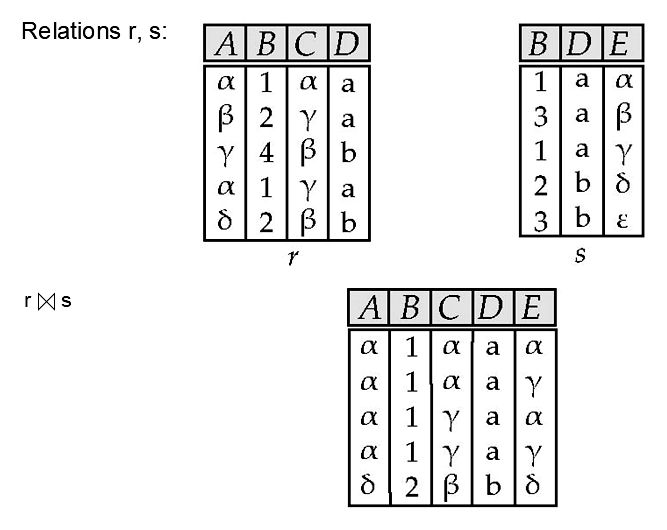
设 \(r(R)\) 和 \(s(S)\) 是两个关系,自然连接的结果模式是 \(R\cup S\)。
如果 \(R=(A,B,C,D)\),且 \(S=(E,B,D)\)。
则公共属性是 \(B\) 和 \(D\)。
自然连接可以写成:
\[ r\bowtie s=\Pi_{r.A,r.B,r.C,r.D,s.E}(\sigma_{r.B=s.B\land r.D=s.D}(r\times s)) \]条件连接 (Theta Join) 把笛卡尔积和选择合并成一个操作:
\[ r\bowtie_{\theta}s=\sigma_{\theta}(r\times s) \]自然连接满足交换律和结合律。若忽略属性显示顺序,\(r\bowtie s\) 与 \(s\bowtie r\) 等价。
4.2 外连接
普通连接只保留匹配成功的元组,未匹配的元组会丢失。外连接 (Outer Join) 在连接结果之外,把某一侧或两侧未匹配的元组补回,并用 null 填充缺失属性。
| 类型 | 记号 | 保留内容 |
|---|---|---|
| 左外连接 | \(r\mathbin{\text{⟕}}s\) | 保留左侧所有元组 |
| 右外连接 | \(r\mathbin{\text{⟖}}s\) | 保留右侧所有元组 |
| 全外连接 | \(r\mathbin{\text{⟗}}s\) | 保留两侧所有元组 |
左外连接可以理解为自然连接结果加上左侧未匹配元组:
\[ r\mathbin{\text{⟕}}s=(r\bowtie s)\cup((r-\Pi_R(r\bowtie s))\times\{(\text{null},\cdots,\text{null})\}) \]右外连接对称地补回右侧未匹配元组:
\[ r\mathbin{\text{⟖}}s=(r\bowtie s)\cup(\{(\text{null},\cdots,\text{null})\}\times(s-\Pi_S(r\bowtie s))) \]全外连接同时保留两侧未匹配元组:
\[ r\mathbin{\text{⟗}}s=(r\mathbin{\text{⟕}}s)\cup(r\mathbin{\text{⟖}}s) \]4.3 半连接
半连接 (Semijoin) 只保留左侧中至少能在右侧找到匹配的元组,不把右侧属性拼接进结果。
半连接可以由条件连接和投影定义:
\[ r\ltimes_{\theta}s=\Pi_R(r\bowtie_{\theta}s) \]例如相关子查询中的 exists 常可改写为半连接。查询 2022 年授课教师姓名可表示为:
半连接的重点是“判断存在匹配”,而不是把两侧属性完整拼接出来。
4.4 空值逻辑
涉及 null 的比较不会得到普通的 true 或 false,而会得到 unknown。SQL 因此采用三值逻辑。
| 表达式 | 结果 |
|---|---|
unknown or true | true |
unknown or false | unknown |
unknown and true | unknown |
unknown and false | false |
not unknown | unknown |
在 where 条件中,结果为 unknown 的元组不会被选中。若要判断谓词本身是否为 unknown,可以使用 is unknown。
4.5 赋值除法
赋值 (Assignment) 用于把复杂查询拆成多个临时关系。它不增加表达能力,但能让推导更清晰。
除法 (Division) 用于表达“对所有”的查询。
给定 \(r(R)\) 和 \(s(S)\),并且 \(S\subset R\)。
\(r\div s\) 是最大的关系 \(t(R-S)\),使得:
\[ t\times s\subseteq r \]换句话说,结果中的每个 \(t\) 都必须能和 \(s\) 中每个元组组合,并且组合结果都出现在 \(r\) 中。
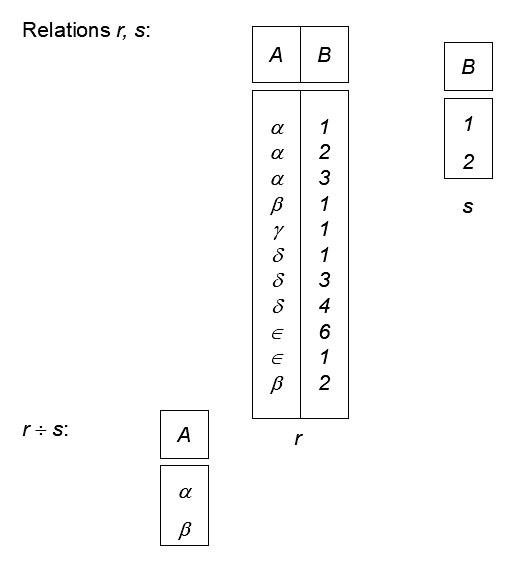
例如设 \(r(\text{ID},\text{course_id})\) 表示学生选过的课程。
设 \(s(\text{course_id})\) 表示生物系开设的所有课程。
则 \(r\div s\) 得到选过所有生物系课程的学生。
除法可用基本操作表示。先取所有可能的左侧候选:
\[ \text{temp}_1\leftarrow \Pi_{R-S}(r) \]再找出那些缺少某个 \(s\) 元组匹配的候选:
\[ \text{temp}_2\leftarrow \Pi_{R-S}((\text{temp}_1\times s)-\Pi_{R-S,S}(r)) \]最后从候选中删去不合格者:
\[ r\div s=\text{temp}_1-\text{temp}_2 \]5. SQL 语义
5.1 广义投影
广义投影 (Generalized Projection) 允许在投影列表中使用算术表达式,而不仅是属性名:
\[ \Pi_{F_1,F_2,\cdots,F_n}(E) \]其中 \(F_i\) 可以由常量和 \(E\) 中的属性组成。
例如 salary 表示年薪时,可以投影出月薪:
5.2 聚集操作
聚集函数 (Aggregate Function) 接收一组值并返回一个值。常见聚集函数包括 avg、min、max、sum 和 count。
聚集操作的一般形式是:
\[ _{G_1,G_2,\cdots,G_n}\mathcal{G}_{F_1(A_1),F_2(A_2),\cdots,F_m(A_m)}(E) \]其中 \(G_1,G_2,\cdots,G_n\) 是分组属性,可以为空。
其中 \(F_i(A_i)\) 表示对属性 \(A_i\) 使用聚集函数 \(F_i\)。
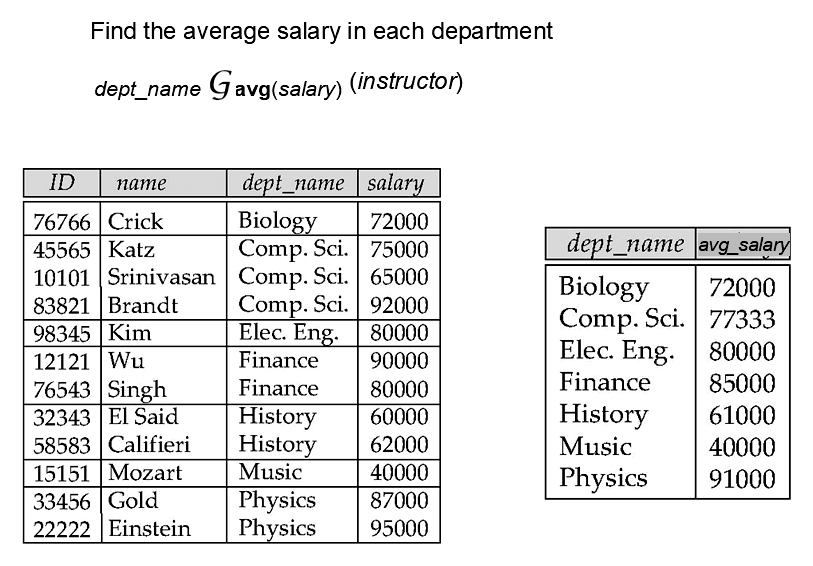
按院系求平均工资可以写成:
\[ _{\text{dept_name}}\mathcal{G}_{\text{avg}(\text{salary})}(\text{instructor}) \]聚集结果默认没有属性名,实际使用时常通过重命名给它命名:
\[ _{\text{dept_name}}\mathcal{G}_{\text{avg}(\text{salary})\ \text{as}\ \text{avg_sal}}(\text{instructor}) \]5.3 数据修改
数据库内容可以通过删除、插入和更新修改。这些操作也能用赋值思想表达。
| 操作 | 关系代数表达 |
|---|---|
| 删除满足 \(P\) 的元组 | \(r\leftarrow r-\sigma_P(r)\) |
| 插入关系 \(E\) 的结果 | \(r\leftarrow r\cup E\) |
| 更新属性值 | 删除旧元组后插入新元组 |
关系代数本身主要用于查询表达;数据修改语句需要额外考虑约束检查、触发器、并发控制和日志恢复。
5.4 多重集语义
纯关系代数使用集合语义,会自动去除重复元组。SQL 默认使用 多重集 (Multiset) 语义,除非显式使用 distinct,否则会保留重复行。
多重集语义下,设元组 \(t\) 在 \(r\) 中出现 \(m\) 次。
再设同一元组在 \(s\) 中出现 \(n\) 次。
集合操作的重复次数如下:
| 操作 | 重复次数 |
|---|---|
| 并 | \(m+n\) |
| 交 | \(\min(m,n)\) |
| 差 | \(\max(0,m-n)\) |
选择操作保留输入中的重复次数,只要元组满足谓词。
投影操作对每个输入元组产生一个输出元组,因此可能保留重复投影结果。
笛卡尔积中,若左侧元组出现 \(m\) 次、右侧元组出现 \(n\) 次,拼接结果出现 \(mn\) 次。
5.5 SQL 对应
不含聚集的 SQL 查询可以看作选择、投影和笛卡尔积的组合:
select A1, A2, ..., An
from r1, r2, ..., rm
where P;
它对应的多重集关系代数表达式是:
\[ \Pi_{A_1,A_2,\cdots,A_n}(\sigma_P(r_1\times r_2\times\cdots\times r_m)) \]带分组聚集的 SQL 查询可以先做笛卡尔积和选择,再按分组属性聚集:
select A1, A2, sum(A3)
from r1, r2, ..., rm
where P
group by A1, A2;
它对应的关系代数表达式是:
\[ _{A_1,A_2}\mathcal{G}_{\text{sum}(A_3)}(\sigma_P(r_1\times r_2\times\cdots\times r_m)) \]如果 select 中只输出部分分组属性,则可先按完整 group by 属性聚集,再对最终结果投影。